
Crowns, Bridges & Dentures
Restoring damaged or missing teeth — with materials and methods that look natural and last.
Metal-free zirconia crowns, custom-fitted bridges when implants aren’t possible, and well-made dentures that actually fit. We work with our dedicated dental laboratory to ensure consistent quality on every restoration.
When You May Need Prosthetic Treatment
Prosthetic restorations rebuild what’s been damaged or lost — restoring both function and appearance.
Crowns
A crown covers an entire tooth, restoring its strength, shape, and appearance. We recommend crowns when:
· A tooth is severely damaged or broken
· A large filling has weakened the remaining tooth
· After a root canal treatment (almost always needed)
· To protect a cracked tooth from further damage
· To improve the appearance of a discolored or misshapen tooth
We use only metal-free zirconia crowns — strong, durable, and natural-looking.
Bridges
A bridge replaces one or more missing teeth by anchoring the replacement to adjacent teeth.
In most cases, we recommend implants over bridges — implants stand independently in the jaw and don’t require grinding down healthy neighboring teeth.
We recommend bridges only when implants aren’t possible — for example, when a patient cannot undergo implant surgery for medical reasons, when bone is severely deficient, or when the adjacent teeth already need crowns anyway.
Dentures
Dentures replace multiple missing teeth or full arches when implants aren’t the right option.
· Partial dentures replace several missing teeth while preserving remaining natural ones
· Complete dentures restore an entire upper or lower arch
Modern dentures are far more comfortable and natural-looking than older versions. With careful fitting and adjustment, most patients adapt well within a few weeks.
What Sets 365 E-LOOK Apart
Prosthetic restorations are something you’ll live with for years. The materials we use, the precision of fit, and the lab we work with all matter.
Metal-Free Zirconia Only
We don’t use gold crowns or metal-fused-to-porcelain (PFM) restorations. All our crowns and bridges are made of zirconia — both single-layer and multi-layer types depending on what suits your tooth best.
Why zirconia? It offers excellent strength comparable to metal-based crowns, no dark metal showing through the gum line over time, and a natural translucent appearance that blends seamlessly with surrounding teeth. No metallic taste, no allergy concerns.
Digital Impressions with Primescan
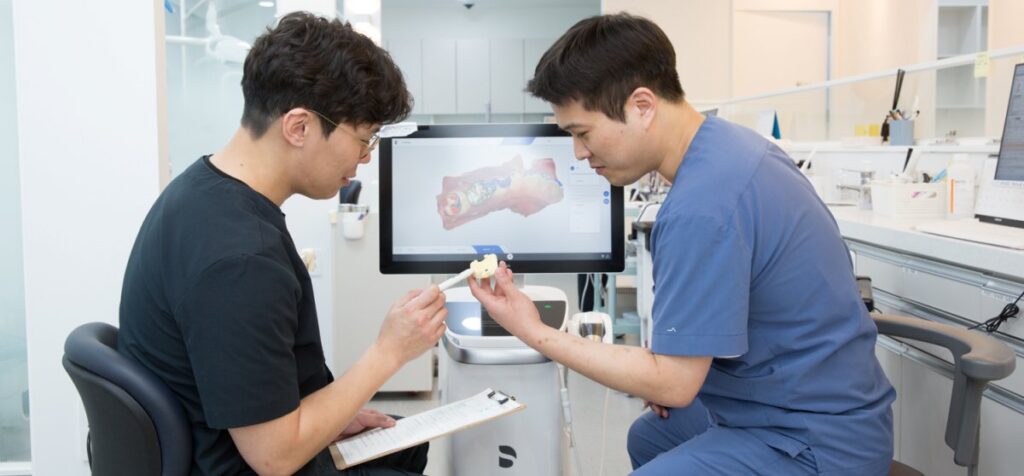
We use the Dentsply Sirona Primescan — one of the most accurate intraoral scanners available — to capture precise 3D impressions of your teeth.
No more biting into uncomfortable putty trays. Digital impressions are faster, more comfortable, and produce significantly more accurate fits than traditional methods. Your final restoration fits better and lasts longer because of it.
Dedicated Laboratory Partner
We work exclusively with one trusted dental laboratory we’ve partnered with for years. The technicians know our standards, communicate with us directly, and consistently deliver high-quality work.
Many clinics rotate between different labs to lower costs, leading to inconsistent results. Our long-term lab relationship means every restoration meets the same quality standard — every time.
What to Expect
Most prosthetic cases are completed in 2 to 3 visits over 2 to 3 weeks.
Step 1 — Diagnosis & Planning
Your first visit begins with a thorough examination, X-rays, and a discussion of your goals — function, appearance, longevity, and budget.
For complex cases, we may take a 3D CT scan or impressions for treatment planning. We’ll explain the recommended approach, the materials we’d use, and the expected timeline. You’ll receive a clear cost estimate before any treatment begins.
Duration: about 30 to 45 minutes.
Step 2 — Tooth Preparation
For crowns and bridges, the tooth is shaped to receive the restoration. Before any preparation, we apply a topical anesthetic followed by computer-controlled slow-injection local anesthesia, so you don’t feel pain during the procedure.
For dentures, this step involves taking initial measurements and impressions of your jaw and remaining teeth.
A temporary restoration is usually placed at this visit to protect the prepared tooth (or temporary teeth in the case of dentures) until the final restoration is ready.
Duration: about 60 to 90 minutes.
Step 3 — Digital Impression
Once the tooth is prepared (or for dentures, once tissues have healed appropriately), we use the Primescan intraoral scanner to capture precise 3D impressions.
The digital data is sent directly to our dedicated dental laboratory, where your custom restoration is fabricated to match the color, translucency, and shape of your natural teeth. Lab fabrication typically takes 1 to 2 weeks.
Duration: about 30 minutes.
Step 4 — Final Placement
At your final visit, we carefully fit the completed restoration. We check the bite, contact points, color match, and overall comfort, making any necessary adjustments before permanent cementation.
For dentures, this visit involves trying on the finished prosthesis and making careful adjustments for comfort and function. We provide detailed care instructions and schedule a follow-up to ensure everything is working well.
Duration: about 60 minutes.
Common Questions About Prosthetic Treatment
How long do crowns and bridges last?
With proper care, zirconia crowns and bridges typically last 15 to 20 years or longer.
Lifespan depends on factors like your bite force, oral hygiene habits, and whether you grind your teeth at night. Patients with bruxism (grinding) may experience faster wear; we may recommend a night guard to protect your investment.
Regular cleanings every 6 months help us catch any early issues before they require replacement.
Why do you only use zirconia crowns?
We’ve found that zirconia provides the best combination of strength, aesthetics, and biocompatibility for the vast majority of cases.
Compared to gold crowns: similar strength, but natural-looking
Compared to PFM (porcelain-fused-to-metal): no risk of dark metal showing at the gum line over time, and no metallic taste
Compared to all-ceramic alternatives: stronger and less prone to chipping
For very specific clinical situations, other materials may occasionally be appropriate — but for everyday crowns and bridges, zirconia is consistently the best choice.
Why do you usually recommend implants over bridges?
A traditional bridge requires grinding down the two healthy teeth on either side of the gap to anchor the replacement. This permanently damages those teeth and weakens them over time.
An implant stands independently in the jaw, preserving your healthy neighboring teeth completely. For most patients in good health, implants offer a more durable, conservative long-term solution.
We recommend bridges only when implants aren’t suitable — for example, when bone is severely deficient, when implant surgery isn’t medically advisable, or when the adjacent teeth already need crowns for other reasons.
How long does it take to get used to dentures?
Most patients adapt to new dentures within 2 to 4 weeks. The first few days can feel strange — speech may be slightly affected, and certain foods may be more challenging at first.
Some tips for the adjustment period:
· Start with softer foods and cut everything into smaller pieces
· Practice reading aloud to adjust your speech
· Use denture adhesive if needed for added stability while adapting
· Schedule follow-up adjustments — small refinements can make a big difference
We provide thorough aftercare guidance and welcome you back for adjustments as often as needed.
What about TRICARE coverage?
The TRICARE Dental Program (TDP) covers most prosthetic procedures, including crowns, bridges, and dentures, with cost shares varying by procedure and plan tier.
For Command-Sponsored patients, coverage is typically more favorable. Non-Command-Sponsored patients may have partial coverage.
Major restorative work like crowns and dentures often involves both surgical/preparation visits and laboratory work, which TDP handles in stages. We’ll verify your specific benefits and provide a clear cost breakdown — including expected out-of-pocket costs — before treatment begins.
Ready to Restore Your Smile?
Whether you need a single crown, a bridge, or a complete denture — we’re here to help you find the right solution and execute it well.
A consultation with examination and imaging applies a fee, as accurate diagnosis requires proper evaluation. With that information, we’ll explain your options, materials, costs, and expected outcomes clearly.
Phone: 031-8029-6622
You can also message us via KakaoTalk or Naver Talk using the buttons at the bottom right of your screen.
Medically reviewed by Dr. Junsang Lee, DDS — Director, 365 E-LOOK Dental | Last updated: June 2026