
Dental Implants
Replace missing teeth with the closest thing to natural — by a team that handles even the most challenging cases.
From routine implants to bone grafts, sinus lifts, and full-arch reconstructions — all under one roof in Pyeongtaek Godeok.
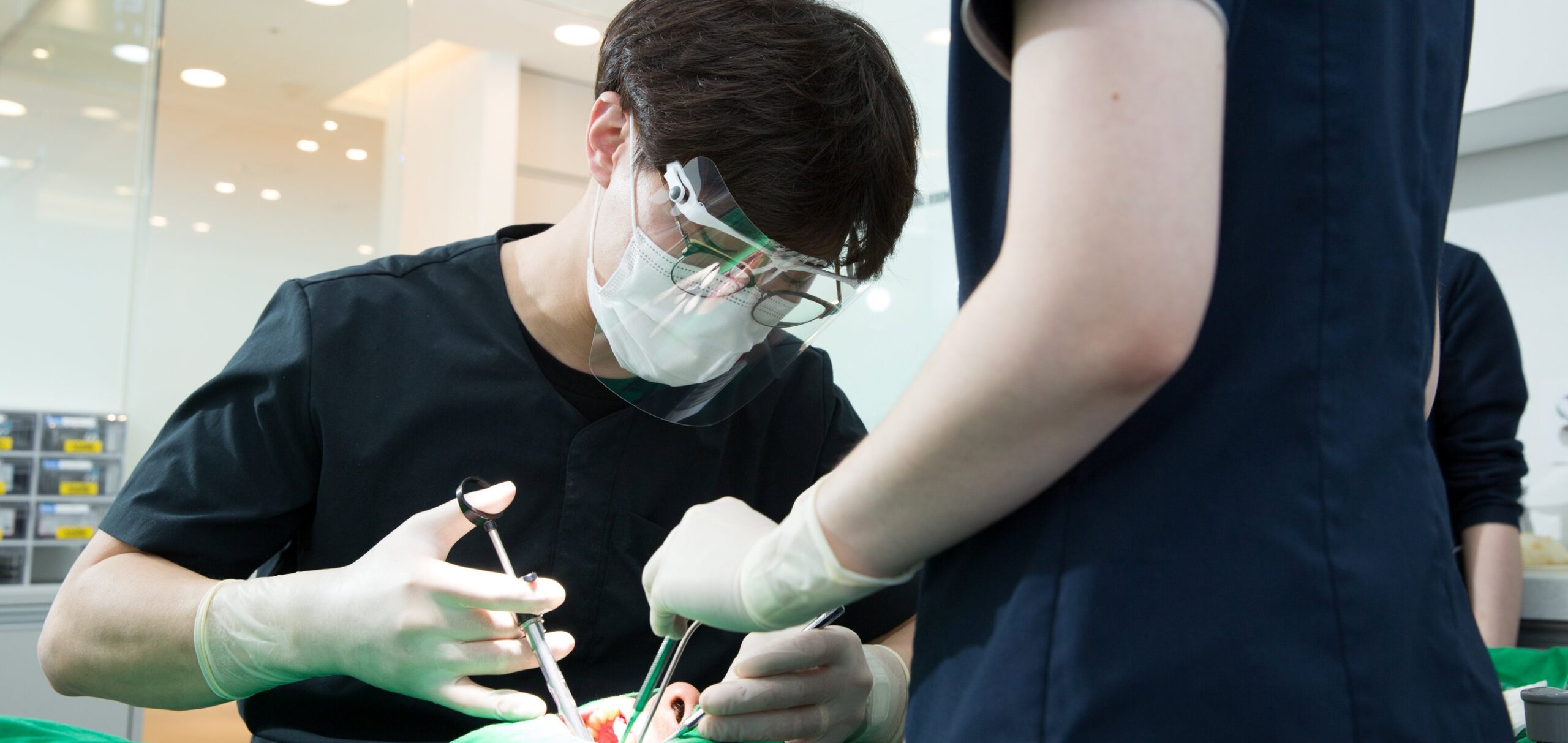
When Are Dental Implants the Right Choice?
Implants are often the best long-term solution for missing or failing teeth. Here’s when you should consider them.
Missing Teeth
Whether you’ve lost a tooth recently or have been living with a gap for years, an implant restores both function and appearance — without affecting neighboring teeth like a bridge would.
Best for: single missing teeth, multiple missing teeth, full-arch tooth loss
Failing Teeth
Some teeth can’t be saved despite our best efforts — severely cracked teeth, advanced gum disease, repeatedly failed root canals, or large infections that have destroyed bone structure.
In these cases, planned extraction with implant replacement often gives a far better long-term outcome than trying to preserve a failing tooth.
Long-Term Solution Over a Bridge
A traditional bridge requires grinding down the healthy teeth on either side of the gap to anchor the replacement — which weakens those teeth over time.
An implant stands independently in the jaw, preserving your healthy neighboring teeth completely. For most patients in good health, implants offer a more durable, conservative long-term solution than bridges.
What Sets 365 E-LOOK Apart
Implant treatment isn’t just about placing a screw — it’s about precision, planning, and accountability. Here’s how we approach it differently.
Cases Others Refer Out
Severely resorbed bone, sinus lift surgery, large bone grafts, removal of failed implants, full-arch reconstructions — these cases are often referred to university hospitals.
Our three directors have over a decade of surgical experience each. We’ve completed advanced training including the AIC Osstem Implant program, AMII IBS Implant course, and Seoul National University implant programs. Most complex cases can be handled here in Pyeongtaek Godeok — no hospital trip needed.
3D-Guided Precision
Every implant case begins with low-dose 3D CT imaging to map your bone structure, nerve pathways, and sinus position with millimeter accuracy.
This planning allows us to place implants safely — avoiding nerves, optimizing bone contact, and predicting the final aesthetic result before surgery even begins. The same scan gives you a clear picture of your treatment options.
Same Doctor, Start to Finish
At larger clinics, your initial consultation might be with one doctor, your surgery with another, and follow-up care with yet another.
At 365 E-LOOK, the doctor who diagnoses you also performs the surgery, places the final crown, and handles all follow-up care. They remember your case in detail, and you never have to repeat your story to a new face.
The Implant Process
A typical implant case takes 3 to 6 months from start to finish. Here’s what to expect at each stage.
Step 1 — Consultation & 3D Imaging
We begin with a thorough examination, low-dose 3D CT scan, and a detailed conversation about your goals, medical history, and concerns. We’ll review your treatment options — including alternatives to implants when appropriate — and provide a clear cost estimate before any work begins.
Duration: about 1 hour for the first visit.
Step 2 — Implant Placement Surgery
Using 3D-guided planning, we place the titanium implant fixture into your jawbone. Most patients describe this as easier than they expected — typically less uncomfortable than a difficult tooth extraction.
If bone grafting or sinus lift is needed, it can often be performed at the same visit. We use a multi-stage pain management approach: topical anesthetic before injection, followed by computer-controlled slow-injection local anesthesia, so the area is fully numbed before any work begins.
Duration: 30 to 90 minutes depending on complexity.
Step 3 — Healing & Osseointegration
Over the next 3 to 6 months, your bone fuses to the implant surface — a process called osseointegration. This is what gives implants their long-term stability.
During this period, you’ll have temporary tooth replacement options as needed, and we monitor healing through periodic check-ups. Most patients return to normal activities within a few days of surgery.
Step 4 — Impression with Digital Scanner
Once healing is complete, we use the Dentsply Sirona Primescan to capture a precise 3D impression of your mouth — no uncomfortable putty trays. This data is sent to our dedicated dental laboratory partner — a long-established relationship that ensures consistent quality and fit, every time.
Duration: about 30 to 60 minutes.
Step 5 — Final Crown Placement
At your final visit, we attach the custom-made crown to the implant. We carefully verify the fit, bite, and aesthetics, making any final adjustments needed.
You leave with a fully functional, natural-looking tooth — and a maintenance plan to keep it healthy for decades to come.
Duration: about 1 hour.
Common Questions About Implants
A typical implant case takes 3 to 6 months from start to finish. Here’s what to expect at each stage.
Does it hurt?
Most patients are surprised by how comfortable implant surgery is — many describe it as easier than a difficult tooth extraction.
We use multi-stage pain management: a topical anesthetic to numb the surface tissue first, followed by computer-controlled slow-injection anesthesia to minimize the “pinch” of the needle. During the procedure itself, the area is fully numbed.
Mild soreness for a few days after surgery is normal and easily managed with over-the-counter pain relievers.
How long do dental implants last?
With proper care, dental implants are designed to last decades — many studies show success rates above 95% at 10 years.
Reference: Howe MS et al., “Long-term (10-year) dental implant survival: A systematic review,” Journal of Dentistry, 2019.
Long-term success depends on three things: high-quality surgery and components (which we control), good home oral hygiene (which you control), and regular professional cleanings every 4 to 6 months.
Patients with controlled diabetes, heavy smokers, or those with bruxism (grinding) may have slightly different prognoses — we’ll discuss your specific factors during consultation.
Am I a candidate for implants?
Most adults with one or more missing teeth are good candidates. The main factors we evaluate:
· Sufficient bone height and width (or willingness to undergo bone grafting if needed)
· Healthy gum tissue
· General medical health (controlled blood pressure, diabetes, etc.)
· Non-smoker or willingness to quit during healing
· Ability to maintain good oral hygiene
Even patients told elsewhere that they “can’t get implants” often have options. We’ll review your specific situation honestly during consultation.
What about TRICARE coverage?
The TRICARE Dental Program (TDP) provides limited coverage for implants — typically the surgical placement and crown are covered at varying levels, with annual maximums applying.
Many patients find that combining TDP benefits with our self-pay rates makes implant treatment significantly more affordable here in Korea than back in the United States.
We’ll verify your specific coverage and provide a detailed cost breakdown before any treatment begins.
What if I don't have enough bone for an implant?
Insufficient bone is one of the most common reasons people are told they “can’t get implants” — but in most cases, it can be addressed with bone grafting or sinus lift procedures.
We perform these advanced procedures routinely. Depending on the amount of bone needed:
· Minor grafts can often be done at the same time as implant placement
· Larger grafts may require a separate procedure with 3 to 6 months healing time before implant placement
· Sinus lifts (for upper back teeth) are commonly needed and routinely performed here
Don’t assume you can’t get implants without a 3D evaluation — many patients are pleasantly surprised.
Ready to discuss your options?
Every implant case is unique. The first step is a thorough consultation that includes 3D CT imaging and a complete examination — so we can give you honest, personalized guidance based on your specific situation.
A consultation fee applies, as accurate diagnosis requires proper imaging and clinical evaluation. With that information, we’ll review your options, costs, and timeline clearly — and answer every question you have.
Phone: 031-8029-6622
You can also message us via KakaoTalk or Naver Talk using the buttons at the bottom right of your screen.
Medically reviewed by Dr. Junsang Lee, DDS — Director, 365 E-LOOK Dental | Last updated: June 2026