
Wisdom Tooth Extraction: Do You Really Need a University Hospital? — When a Local Clinic Is Enough and When Referral Is the Right Call
Dr’s Notes
There’s a line I hear constantly in wisdom tooth consultations: “Another clinic told me to go to a big hospital.” And the line that usually follows: “But the university hospital booked me two months out — do I just stay in pain until then?”
The short answer: a large share of wisdom teeth can be extracted safely at a local dental clinic, and some absolutely should go to a university hospital. What matters is that the dividing line isn’t the size of the clinic — it’s the condition of the tooth and the patient’s overall health. Here’s how to judge that distinction as a patient.
Cases a local clinic can handle
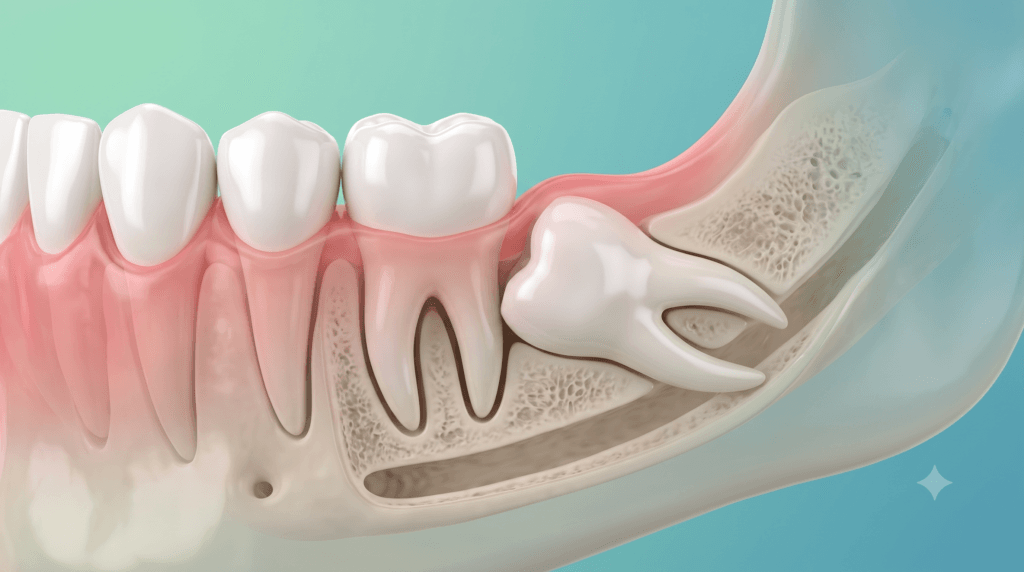
A normally erupted wisdom tooth, or one partially covered by gum but in a favorable position, is routine clinic-level extraction. Even a lower wisdom tooth lying horizontally (a horizontal impaction) can be extracted at an experienced clinic — if panoramic imaging, and CBCT when needed, confirms adequate distance from the nerve canal.
What actually determines the difficulty isn’t whether the tooth is “lying down” but the relationship between its roots and the inferior alveolar nerve — the sensory nerve of the lower jaw. That relationship can’t be fully judged by eye or by a single panoramic X-ray; in borderline cases, a 3D CBCT scan settles it.
Cases that belong at a university hospital
If your dentist recommends referral in the following situations, that’s not a lack of skill — it’s correct judgment.
Roots touching or wrapped around the nerve canal. When CBCT shows the roots hugging or compressing the inferior alveolar canal, extraction carries a risk of altered sensation — numbness in the lip or chin. University hospitals can also consider alternatives such as coronectomy, removing only the crown and deliberately leaving the roots.
Systemic conditions or medications. Heart conditions requiring uninterrupted anticoagulants, long-term antiresorptive therapy for osteoporosis (bisphosphonates and similar), poorly controlled diabetes, or immunosuppression — in these cases the challenge isn’t the extraction itself but managing bleeding, bone healing, and infection afterward, which calls for a hospital with medical co-management.
An upper wisdom tooth intimate with the maxillary sinus, or a large cyst or lesion formed around the tooth, falls in the same category.
Severe dental anxiety requiring sedation or general anesthesia. Anesthesia itself needs proper safety infrastructure, so a facility equipped for it is the right destination.
What you can check as a patient
Ask two things at any clinic you consult. First, how do they assess the nerve relationship before extracting? If the position looks ambiguous and the answer is “let’s just pull it” based on a panoramic film alone, think twice; if the answer involves confirming with CBCT when needed and deciding based on that, that’s a clinic you can trust. Second, do they have referral criteria? A clinic that can say “in these cases we send patients to a hospital” is safer than one that says “we extract everything.”
And leaving a repeatedly painful wisdom tooth untreated for months while waiting for a university hospital slot isn’t the answer either. Acute inflammation around the tooth (pericoronitis) can be calmed first at a local clinic with irrigation and medication — and once properly diagnosed, many cases turn out not to need the university hospital at all. The right sequence is: accurate diagnosis nearby, first.
Frequently asked questions
Does a horizontally impacted wisdom tooth automatically mean a university hospital? No. Even horizontal impactions are often extractable at a general clinic if there’s confirmed distance from the nerve canal. The criterion is the nerve relationship and your overall health — not the tooth’s angle.
Can all four wisdom teeth come out at once? It’s possible, but usually under general anesthesia or deep sedation, and recovery is demanding. Splitting it into two visits — one side (upper + lower) at a time — typically keeps eating and daily life manageable.
Should a painless wisdom tooth still come out? Not necessarily. But even a fully impacted, symptom-free tooth can resorb the neighboring molar or form a cyst, so periodic radiographic monitoring is essential. “It doesn’t hurt, so I don’t need to check” is the riskiest assumption of all.
This article is for general information; individual diagnosis and treatment planning require an in-person examination.