How Well You Chew Is What Remains — What Can Still Be Recovered
Dr’s Notes · Teeth and Whole-Body Health, Part 3 of 3
Parts 1 and 2 may not have been comfortable reading. They were full of numbers showing that the more teeth you lose, the higher your risk of heart disease, pneumonia, and dementia. If you have already lost several teeth, you may have found yourself asking, “So what happens to me?”
This article is written for you. Part 2 ended on the finding that the variable that reverses the risk is not the teeth themselves but the ability to chew. The next question follows naturally: which method restores that ability best?
Prostheses bring it back — but not all of it
The good news first. Restoring chewing function with any prosthesis brings back a large share of the risk. In a cohort of 36,283 older adults in China, wearing dentures lowered the risk of death by about 19%, and as Part 2 showed, dementia risk returned almost to baseline.
But not all of it. In a study of 43,774 older adults in Japan followed for seven years, people with fewer than 10 teeth still ran 1.31 times the risk of cancer death, 1.35 times the cardiovascular risk, and 1.72 times the respiratory risk of people with 20 or more — even with a prosthesis. Lower than without one, but a gap remained.
Why does the gap remain? There are several reasons, but the simplest is this: not all prostheses are equal, and a conventional complete denture restores only about one-tenth of the biting force of natural teeth.
The staircase of recovery
A 2026 study measured this difference in one place. It compared maximum bite force across five groups: people with natural teeth, people with fixed implant-supported prostheses, people with implant overdentures in both jaws, people with an implant overdenture in the lower jaw only, and people with conventional complete dentures in both jaws.
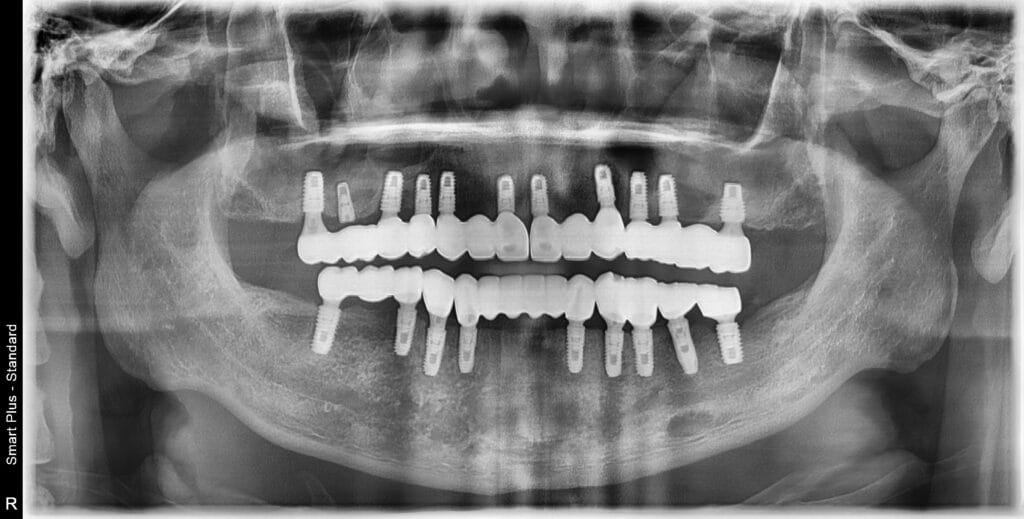
The result was a staircase. Conventional dentures produced about one-tenth of the bite force of natural teeth. Anchoring the lower denture on two implants raised it 2.4 times; anchoring both jaws raised it 4 times. Fixed implant prostheses came closest to natural teeth — and, because they leave room for the tongue and preserve the shape of the palate, they also scored highest for speech clarity.
The same staircase appears elsewhere. Several studies report that implant-anchored dentures generate 60–200% more maximum chewing force than conventional dentures, and a 12-month study found that a single molar replaced with an implant restored bite force and chewing performance close to natural teeth. A 2026 systematic review concluded that in edentulous patients, fixed implant prostheses outperform removable ones in chewing efficiency and occlusal stability, with high long-term survival.
In short: a conventional denture opens the door to chewing, but the door is narrow. Implants widen it, and a fixed prosthesis brings it close to the width of natural teeth.
The muscles come back
In Part 2, I wrote that people who had lost ten or more teeth showed lower grip strength and slower walking even though their muscle mass was unchanged — that function ages before size.
That story has a mirror image. In a study of edentulous patients restored with full-arch fixed implant prostheses in both jaws, the chewing muscles were measured by ultrasound. The masseter and temporalis muscles became significantly thicker, left–right asymmetry decreased, and by six months their thickness was similar to that of people with intact teeth.
The reason is simple. A person wearing conventional dentures spends much of their muscular effort holding the dentures in place; bite hard and the denture lifts, so they learn not to bite hard. Once the prosthesis is anchored on implants, the muscles are freed from holding and devoted entirely to chewing — which is also why chewing time is shortest with implant prostheses. Muscle that is used returns; muscle that is not, shrinks.
Quality of life and diet
Does life change when biting force returns? Here there is a good deal of measurement.
A review pooling improvements in oral-health-related quality of life (GOHAI) after full-arch rehabilitation found gains of 21–25% with conventional dentures, 37–41% with implant overdentures, and 39–43% with full-arch fixed prostheses — nearly double. A 2026 study comparing 140 patients across conventional dentures, implant overdentures, and fixed implant prostheses found significantly better nutritional status (MNA-SF) and quality of life in the fixed-prosthesis group than in the conventional-denture group.
One point needs stating precisely. Implant prostheses clearly improve chewing function, but blood markers of nutrition do not improve on their own. Several systematic reviews reach the same conclusion: restored biting force widens the range of foods a person can eat, but people actually eat more vegetables and protein when their diet changes alongside it. Implants open the door; diet walks through it. That is why we talk about meals with patients who have just received a new prosthesis.
Briefly, on the brain
Part 2 described how chewing reaches the brain. If you chew better, is it better for the brain? There are small signals. A small brain-imaging study found higher hippocampal activity during memory recall and higher cognitive scores after patients moved from conventional dentures to implant overdentures, and a meta-analysis in older adults with mild cognitive impairment found consistently better quality of life with fixed or implant prostheses than with conventional dentures.
But I will not say more than “signals.” No long-term study has yet tracked whether dementia incidence differs by type of prosthesis. What can be said with confidence is that restoring chewing function reaches the brain. That a higher-quality restoration is better for it is a reasonable inference, not a proven fact.
Putting it together
Laid out in order, this is what the three articles add up to.
The most certain thing is to keep 20 teeth. People who maintained 20 or more showed no significant increase in risk on any measure.
If you have already lost teeth, sooner is better. The longer a gap stays empty, the more the opposing tooth drifts, the neighboring tooth tilts, and the jawbone shrinks — and the worse the outcome of any prosthesis placed later.
And then the quality of the recovery remains. A conventional denture restores one-tenth of natural biting force; an implant-anchored denture two to four times that; a fixed implant prosthesis something close to natural teeth. That difference shows up directly in the muscles, in quality of life, and in the range of foods on the table.
Any prosthesis is clearly better than an empty space — on that the research is unambiguous. But when there is a choice, how well you will chew is what decides the years that follow.
A closing note
When I explain prosthetic options to a patient, I ask first not “how many teeth are we replacing” but “how well will you chew.” The number of teeth is the past. Chewing strength is what comes next.
References
- Yuan JQ, Lv YB, Kraus VB, et al. Number of natural teeth, denture use and mortality in Chinese elderly: a population-based prospective cohort study. BMC Oral Health. 2020;20:100.
- Tooth loss, dental prosthesis use, and cause-specific mortality in older Japanese adults: a 7-year cohort study (JAGES). Sci Rep. 2025.
- Investigating the maximum bite force and speech intelligibility in patients requiring prosthetic rehabilitation. 2026. PMID 42080419.
- Comparison of masticatory efficiency between single-piece implant-supported crowns and conventional fixed partial dentures for single posterior tooth replacement: a 12-month prospective observational study. 2026.
- Choosing between fixed and removable prosthetic modalities for completely edentulous patients: a systematic review of evidence-based outcomes. 2026. PMID 41669595.
- Ultrasound analysis of the masseter and anterior temporalis muscles in edentulous patients rehabilitated with full-arch fixed implant-supported prostheses. Clin Oral Investig. 2024.
- Oral-health-related quality of life in elderly edentulous patients with full-arch rehabilitation treatments: a systematic review. 2024.
- Association between prosthetic rehabilitation type, nutritional status, and oral health-related quality of life in completely edentulous adults: a cross-sectional study. BMC Oral Health. 2026.
- Prasad D, et al. Effect of oral and prosthodontic rehabilitation on nutrition and general health outcomes in edentulous elderly populations: a systematic review. Int J Dent. 2026.
- Do implant-supported prostheses affect bioavailability of nutrients of complete and partially edentulous patients? A systematic review with meta-analysis. Clin Nutr. 2021. PMID 33676775.
- Comparison of the effect of conventional and implant-retained overdentures on brain activity and cognition in a geriatric population: a functional MRI study. J Prosthodont Res. 2022;66(3).
- Oral health-related quality of life and prosthetic rehabilitation in patients with mild cognitive impairment and early dementia: a systematic review. 2025. PMID 41025351.
- Qi X, Zhu Z, Plassman BL, Wu B. Dose-response meta-analysis on tooth loss with the risk of cognitive impairment and dementia. J Am Med Dir Assoc. 2021;22(10):2039-2045.
이 글은 일반적인 정보 제공 목적이며, 개별 진단과 치료 계획은 반드시 진료를 통해 결정됩니다.