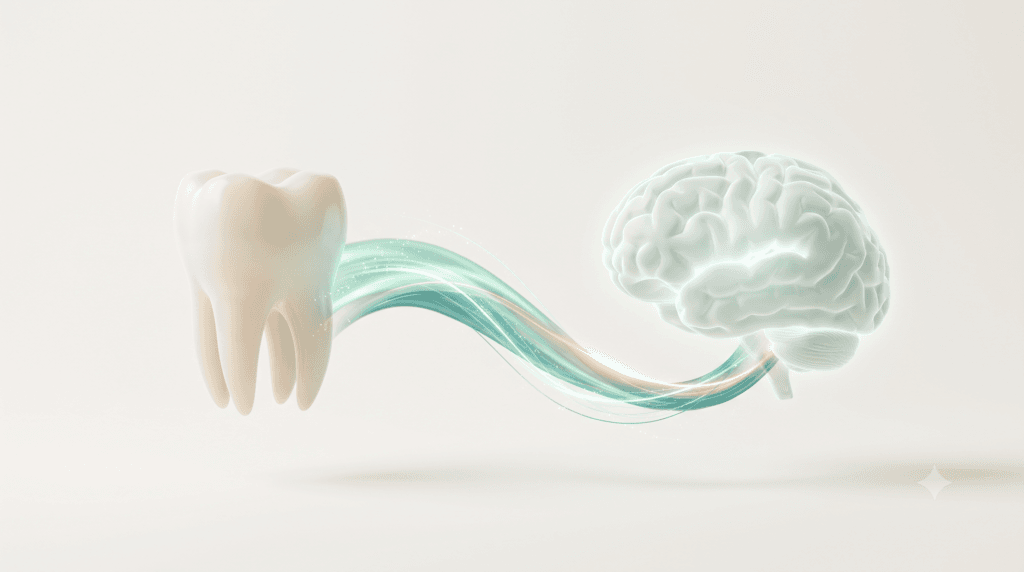
Teeth and the Brain — What Chewing Does for Your Mind
Dr’s Notes · Teeth and Whole-Body Health, Part 2 of 3
Part 1 looked at how the number of teeth you’ve lost connects to the heart and to lifespan. This part is about the brain.
A few years ago, an unfamiliar item began appearing in the medical literature on dementia prevention: teeth. Alongside the well-known risk factors — high blood pressure, diabetes, smoking, hearing loss, physical inactivity — “tooth loss” started to be listed as one of them. This article looks at why that happened, and at what the research actually says.
Three meta-analyses
The link between teeth and dementia has been one of the most heavily tested questions of the past five years. Here are three major syntheses.
2021, Journal of the American Medical Directors Association. People with tooth loss had 1.48 times the risk of cognitive impairment and 1.28 times the risk of dementia. Each missing tooth raised the risk of cognitive impairment by about 1.4% and of dementia by about 1.1%. With no teeth at all, the figures were 1.54 and 1.40.
2023, Frontiers in Neurology. Eighteen cohorts, 356,297 people, an average follow-up of 8.6 years. The conclusion was the same: tooth loss was consistently associated with cognitive decline and a higher risk of dementia.
2026, Journal of Oral Rehabilitation. Twenty-one longitudinal studies pooled. Tooth loss was associated with 1.26 times the risk of dementia and 1.40 times the risk of mild cognitive impairment.
The three sets of numbers land in nearly the same place. Lose teeth, and dementia risk rises roughly 1.3-fold; lose all of them, 1.4- to 1.5-fold. At the earlier stage of memory decline — cognitive impairment — the association is even clearer.
As with the heart in Part 1, the relationship scales with count. Losing ten teeth works out to about 11% higher dementia risk and about 14% higher risk of cognitive impairment.
But with dentures, it disappears
These studies contain one more line. That line is the point of this article.
People who restored their chewing function with dentures or other prostheses did not show an increased risk of dementia.
In the 2021 meta-analysis, people who had lost teeth but wore dentures had a relative dementia risk of 1.10 — statistically indistinguishable from people with intact teeth. In the 2026 meta-analysis, denture wearers came in at 1.03. Another synthesis found 1.53 times the risk in people with tooth loss and no dentures, and 0.98 in those who wore them.
A cohort of older adults in Taiwan divided the picture more finely. The group with 20 or more teeth who also wore dentures where needed had the lowest incidence of dementia (1.43 per 100 person-years). The group with fewer than 20 teeth and no dentures had the highest.
What this says is clear. The variable acting on the brain is not the teeth themselves but the ability to chew. Lose teeth but keep chewing, and the risk returns almost to baseline.
Why chewing reaches the brain
Researchers point to four pathways.
First, cerebral blood flow. Chewing increases blood flow to the brain through the muscles of the face and jaw. Increased brain activity after restoring chewing function has been observed on EEG and functional brain imaging.
Second, nutrition. When the range of foods you can chew narrows, the first things to drop are vegetables, fruit, nuts, and protein — the foods most associated with brain health.
Third, inflammation. The chronic inflammation of periodontitis described in Part 1 also reaches the brain through the bloodstream. Periodontal bacteria have been reported in the brain tissue of Alzheimer’s patients.
Fourth, social withdrawal. Losing teeth undermines confidence in appearance and speech, and people begin to avoid shared meals. Social isolation is itself a major risk factor for dementia.
How much each pathway contributes is not yet known. But all four fit the observation that the risk reverses when chewing function is restored.
The body's age
More recently, studies have begun comparing dental and periodontal status not only with the brain but with the pace of aging across the whole body.
In analyses of the U.S. National Health and Nutrition Examination Survey (NHANES), people with severe periodontitis had a biological age — calculated from blood test markers — that ran 1.1 to 1.2 years ahead of their actual age. And that accelerated aging mediated part of the path from periodontitis to cognitive decline, and to cardiovascular, kidney, and metabolic disease. The picture is of gum inflammation advancing the body’s clock, and the advanced clock showing up in the brain.
Strength and gait show the same signal. In a study of 1,494 community-dwelling older adults in China, men who had lost ten or more teeth had grip strength about 1.6 kg lower, and women walked more slowly. What is interesting is that muscle mass itself did not differ. Function declined before size. When teeth are lost, the first place the body ages may not be the bulk of the muscle but its strength and speed.
A closing note
I have to repeat what I said in Part 1. These are observational studies, and the fact that people who lost teeth developed dementia more often is not the same as concluding that losing teeth caused it. Periodontitis, nutrition, smoking, and socioeconomic status are all tangled together.
Still, there is one thing that sets this topic apart from the other risk factors: the observation that the risk disappears in people who wear dentures. If tooth loss were merely a byproduct of other risk factors, there would be no reason for a set of dentures to change anything. It can be read as evidence that restoring the ability to chew actually changes something.
So this is what I tell patients. Losing teeth is also a question about memory. But it is not a cause for despair. Even after loss, restoring chewing function brings most of it back.
Part 3 is about exactly that — what can be recovered. How much dentures restore, whether implants do better, and what the research still cannot tell us.
References
- Lee HJ, Choi EK, Park JB, Han KD, Oh S. Tooth loss predicts myocardial infarction, heart failure, stroke, and death. J Dent Res. 2019;98(2):164-170.
- Cheng F, Zhang M, Wang Q, et al. Tooth loss and risk of cardiovascular disease and stroke: a dose-response meta-analysis of prospective cohort studies. PLoS One. 2018;13(3):e0194563.
- Liljestrand JM, Havulinna AS, Paju S, Männistö S, Salomaa V, Pussinen PJ. Missing teeth predict incident cardiovascular events, diabetes, and death. J Dent Res. 2015;94(8):1055-1062.
- Peng J, Song J, Han J, et al. The relationship between tooth loss and mortality from all causes, cardiovascular diseases, and coronary heart disease in the general population: systematic review and dose-response meta-analysis of prospective cohort studies. Biosci Rep. 2019;39(1):BSR20181773.
- Suma S, Naito M, Wakai K, et al. Tooth loss and pneumonia mortality: a cohort study of Japanese dentists. PLoS One. 2018;13(4):e0195813.
- Yamato M, Matsuyama S, Murakami Y, et al. Association between the number of remaining teeth and disability-free life expectancy, and the impact of oral self-care in older Japanese adults: a prospective cohort study. BMC Geriatr. 2022;22:820.
- Yuan JQ, Lv YB, Kraus VB, et al. Number of natural teeth, denture use and mortality in Chinese elderly: a population-based prospective cohort study. BMC Oral Health. 2020;20:100.
- The association between the number of teeth and frailty among older adults: a systematic review and meta-analysis. BMC Oral Health. 2025.
이 글은 일반적인 정보 제공 목적이며, 개별 진단과 치료 계획은 반드시 진료를 통해 결정됩니다.