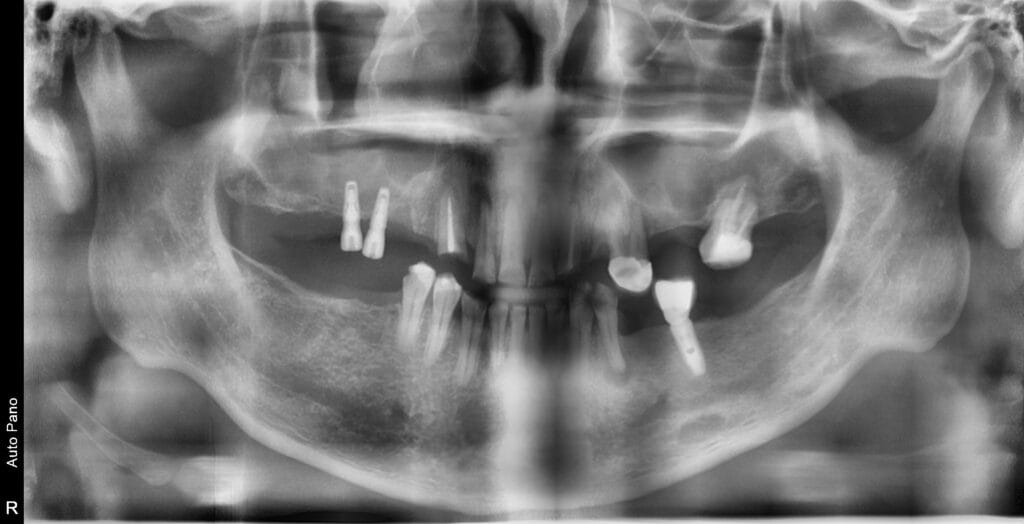
The Weight of a Single Tooth — What the Number of Teeth You've Lost Says About You
Dr’s Notes · Teeth and Whole-Body Health, Part 1 of 3
There is something I hear from patients almost every week: “It’s just one molar. Does it really matter?” It doesn’t hurt to chew, and a back tooth doesn’t show when you smile, so why not leave the gap alone? Let me say first that I respect that decision. But before you make it, I’d like you to know what the research says when it follows the number of teeth and whole-body health side by side, over years.
This is the first of three articles. Part 1 covers the number of teeth and the risk of death and cardiovascular disease. Part 2 covers teeth and the brain. Part 3 is for those who have already lost teeth, and what can still be recovered. Wherever possible, the numbers are taken directly from the papers.
The weight of a single tooth
In 2019, a team at Seoul National University followed 4.44 million people from Korea’s National Health Insurance dental screening database for about seven and a half years. The result was simple. For every tooth lost, the risk of heart attack rose by about 1% and heart failure by about 1.5%, and mortality climbed in step with the number of missing teeth.
One percent per tooth sounds small. But the same figure keeps appearing in other countries and for other diseases, almost in the same place.
- Coronary heart disease and stroke: about 3% higher risk for every two teeth lost, from a meta-analysis pooling 17 cohorts and 880,000 people.
- Death from pneumonia: about 3% higher per tooth, from a study of 19,775 Japanese dentists. Because dentists are a socially homogeneous group, this result filters out much of the effect of income and education.
- Frailty: about 2% per tooth, from a meta-analysis of 25 studies and 36,406 people.
Teeth act on the body not as “present or absent” but as “how many remain.” And the relationship is close to a straight line.
Three, five, ten
Multiply the per-tooth figures above and you get the picture below. These are relative risks from observational studies, so read them as a sense of scale rather than a precise forecast.
| 3 teeth lost | 5 teeth lost | 10 teeth lost | Fewer than 10 remaining | |
|---|---|---|---|---|
| All-cause death | about +5% | +8–10% | +15–20% | +35% or more |
| Heart attack / stroke | +3–5% | +5–8% | +10–15% | Cardiovascular death 1.5–1.7× |
| Death from pneumonia | +10% | +17% | +36% | about 2× |
| Disability-free life expectancy | negligible | negligible | about 1–1.5 years shorter | 2+ years shorter |
Up to three teeth, the difference is statistically detectable but clinically small. In this range, which tooth matters more than how many. A wisdom tooth, or a tooth already restored with a prosthesis, adds almost no risk. A single missing molar that has broken the bite between upper and lower jaws can have an effect larger than the number three suggests.
Two lines
Two points in the table stand out.
First, five. A study that followed 8,446 participants of Finland’s national FINRISK survey for 13 years reported that the risk of coronary heart disease began to rise significantly in people who had lost five or more teeth. At nine or more, the association extended to cardiovascular disease, diabetes, and death. The authors added an interesting suggestion: adding “number of missing teeth” to the standard cardiovascular risk factors improved the ability to identify who was at risk of dying, so physicians might do well to ask patients how many teeth they have.
Second, ten. Several meta-analyses point to this as the threshold where all-cause mortality risk becomes clear. It is also the point where the remaining count drops below 18. In the Ohsaki cohort of older adults in Japan, men with 20 or more teeth had a disability-free life expectancy of 21.6 years; with 10–19 teeth, 20.1 years; with 9 or fewer, 19.0 years. For women the figures were 24.7, 23.5, and 22.6 years. Ten teeth, in effect, trade against one to two years of healthy life.
This is why Japan’s national goal since 1989 — “twenty teeth at eighty,” or 8020 — is not an arbitrary number. Twenty is a line of defense. Above it, almost no indicator shows a significant adverse effect. Below it, risk climbs like a staircase. Approaching complete tooth loss, cardiovascular death rises to 1.5–1.7 times and pneumonia death to twice the baseline.
Why teeth are connected to the heart
Researchers propose three main pathways.
The first is inflammation. The leading cause of tooth loss is periodontitis, and periodontitis is not confined to the gums; it is a chronic inflammation that persists for decades. Bacteria and inflammatory molecules from beneath the gumline enter the bloodstream and accelerate atherosclerosis. The number of teeth lost is a record of how long and how severely that inflammation has run.
The second is nutrition. When the range of foods you can chew narrows, the diet tilts toward soft carbohydrates, and the intake of vegetables, fruit, protein, and other nutrients falls.
The third is shared causes. Smoking, diabetes, and lower income and education make people lose teeth and cause heart disease at the same time. The studies above adjusted for these factors statistically, but separating them completely is not possible.
A closing note
Nearly all the studies in this article are observational. They confirm that people with fewer teeth died earlier, but they cannot confirm with certainty that losing teeth is what caused it. That is why I do not tell patients, “Losing teeth shortens your life.”
I tell them this instead. The number of teeth you’ve lost is the easiest warning light your body offers, and it is one of the few that can be switched off in a dental office. Blood pressure and blood sugar have to be managed every day. Teeth, once protected, stay protected for a long time.
If you decide to leave that one molar missing, I respect the decision. But I’d ask you to make it with the full path in view: the opposing tooth that loses its partner and drifts, the neighboring tooth that tilts into the gap, and the way one becomes three and then five over a few years. From five on, you will feel it.
In the next article, I’ll look at teeth and the brain, and at the research suggesting the real variable is not the teeth themselves but the ability to chew.
References
- Lee HJ, Choi EK, Park JB, Han KD, Oh S. Tooth loss predicts myocardial infarction, heart failure, stroke, and death. J Dent Res. 2019;98(2):164-170.
- Cheng F, Zhang M, Wang Q, et al. Tooth loss and risk of cardiovascular disease and stroke: a dose-response meta-analysis of prospective cohort studies. PLoS One. 2018;13(3):e0194563.
- Liljestrand JM, Havulinna AS, Paju S, Männistö S, Salomaa V, Pussinen PJ. Missing teeth predict incident cardiovascular events, diabetes, and death. J Dent Res. 2015;94(8):1055-1062.
- Peng J, Song J, Han J, et al. The relationship between tooth loss and mortality from all causes, cardiovascular diseases, and coronary heart disease in the general population: systematic review and dose-response meta-analysis of prospective cohort studies. Biosci Rep. 2019;39(1):BSR20181773.
- Suma S, Naito M, Wakai K, et al. Tooth loss and pneumonia mortality: a cohort study of Japanese dentists. PLoS One. 2018;13(4):e0195813.
- Yamato M, Matsuyama S, Murakami Y, et al. Association between the number of remaining teeth and disability-free life expectancy, and the impact of oral self-care in older Japanese adults: a prospective cohort study. BMC Geriatr. 2022;22:820.
- Yuan JQ, Lv YB, Kraus VB, et al. Number of natural teeth, denture use and mortality in Chinese elderly: a population-based prospective cohort study. BMC Oral Health. 2020;20:100.
- The association between the number of teeth and frailty among older adults: a systematic review and meta-analysis. BMC Oral Health. 2025.
이 글은 일반적인 정보 제공 목적이며, 개별 진단과 치료 계획은 반드시 진료를 통해 결정됩니다.