Dental Emergency Near Osan Air Base or Camp Humphreys? What to Do After Hours and on Weekends
Dr’s Notes — for U.S. military families near Camp Humphreys and Osan Air Base
Dental emergencies have a talent for bad timing. The crown comes off on a Saturday evening. The toothache that was “manageable” all week becomes unbearable at 10 p.m. A kid takes a soccer ball to the face on a Sunday afternoon. And if you’ve recently arrived in Korea, the question isn’t just what do I do — it’s where do I even go, in a country whose medical system you haven’t figured out yet.
As a dentist practicing in Pyeongtaek, I see the aftermath of these situations regularly, and the difference between a good and bad outcome often comes down to what happened in the first hour. So this post covers two things: how to triage the problem yourself, and how after-hours dental care actually works in Korea.
If you’ve recently PCS’d to Pyeongtaek, one of the questions that comes up quickly — usually after the boxes are unpacked and someone’s tooth starts hurting — is how dental care actually works off base in Korea. As a dentist who treats TRICARE Dental Program (TDP) families regularly, I want to walk through how the system works from the clinic side, because understanding the mechanics ahead of time saves a lot of confusion at the front desk.
This is not official TRICARE guidance. Policies change, and your specific coverage depends on your sponsor’s status and pay grade. Always verify details with United Concordia directly. What follows is a practical explanation of how the process typically unfolds when you visit a Korean dental clinic.
First: is this an emergency room problem or a dental clinic problem?
Not every dental crisis belongs at a dentist’s office. Go to a hospital emergency room — or call 119 (Korea’s emergency number, with English interpretation available) — if any of these apply:
- Facial or neck swelling that is spreading, especially if it affects swallowing, breathing, or opening your eyes. A dental abscess that spreads into the deep spaces of the neck can become life-threatening. This is not a wait-until-morning situation.
- Bleeding that won’t stop after 20–30 minutes of firm, continuous pressure with gauze.
- Trauma with a suspected jaw fracture — the teeth no longer meet the way they used to, the jaw won’t open or close properly, or there’s numbness in the chin or lip after an impact.
- A blow to the head with loss of consciousness, vomiting, or confusion — the tooth is now the least of your concerns.
One honest caveat about Korean emergency rooms: most do not have a dentist on duty. The ER will manage the airway, the bleeding, the fracture, the infection — the things that threaten you — and refer the tooth itself to a dental clinic afterward. That’s the correct division of labor, but it surprises many American families who expect an ER to fix the tooth. It usually won’t.
Everything below the ER threshold — severe toothache, broken tooth, knocked-out tooth, lost crown, abscess without spreading swelling — belongs at a dental clinic, and speed still matters for some of them.
The one true minutes-matter emergency: a knocked-out permanent tooth
If a permanent tooth is knocked completely out, the clock starts immediately. Reimplantation works best within 30–60 minutes, and every minute the root surface spends dry lowers the odds.
- Find the tooth and pick it up by the crown — the white chewing part. Do not touch or scrub the root.
- If it’s dirty, rinse it briefly — a few seconds under cold running water or saline. No soap, no scrubbing, no wrapping it in tissue.
- Best option: put it back in the socket yourself, facing the right way, and have the person bite gently on gauze or a clean cloth to hold it. This sounds alarming but it is the single best thing you can do.
- If reimplanting isn’t possible, keep the tooth in cold milk, or in the person’s own saliva (inside the cheek works for a calm adult). Plain water is a last resort — it damages the root cells.
- Get to a dentist immediately. Call ahead so the clinic is ready when you arrive.
Critical exception for parents: do not reimplant a baby tooth. Pushing a primary tooth back in can damage the permanent tooth developing underneath it. If you’re not sure whether it’s a baby or permanent tooth — a reasonable doubt around ages 5–7 — bring the tooth in milk and let the dentist decide. The child should still be seen promptly to check for other injuries.
Common after-hours problems and what to do until you're seen
Severe toothache. Take an over-the-counter pain reliever according to the package directions — for most adults, ibuprofen is effective for dental pain. Do not place aspirin against the gum; it burns the tissue and helps nothing. Cold compress outside the cheek, head elevated when lying down. A toothache that wakes you from sleep or throbs with your heartbeat usually means the nerve is involved — it will not resolve on its own, so get seen within a day or two even if the pain temporarily fades. A toothache that suddenly stops hurting is not always good news; sometimes it means the nerve has died, and the infection phase comes next.
Chipped or broken tooth. Save any fragments in milk or saline — sometimes they can be bonded back. If the broken edge is sharp, dental wax or even sugar-free gum over the edge protects the tongue. Sensitivity to cold suggests the fracture is near the nerve; see a dentist within a day or two. Visible pink or bleeding at the center of the broken surface means the nerve is exposed — that’s a same-day visit.
Crown or bridge came off. Keep it — do not throw it away, and do not swallow it. In most cases it can be recemented if you’re seen within a few days, and I covered when that’s possible in a separate post. What matters after hours: don’t glue it back with anything from a hardware store. Superglue and similar adhesives make proper recementation difficult and can damage the tooth underneath. If the exposed tooth is sensitive, a dab of dental wax or temporary dental cement from a pharmacy can cover it for a day or two.
Swelling or a pimple on the gum (abscess). A localized gum swelling with a bad taste is an infection finding a way to drain. It needs treatment — usually of the tooth itself, not just antibiotics — but it’s a next-available-appointment problem, not an ER problem, unless the swelling starts spreading into the face or neck (see the ER list above). Warm salt-water rinses can ease it in the meantime. Don’t try to pop it.
Something stuck between teeth. Dental floss, gently. Never anything sharp or metal. If floss fails, that’s what we’re here for — clinics remove more popcorn hulls and rib fragments than you’d guess.
How after-hours dental care actually works in Korea
Here’s the structural thing that catches new arrivals: most Korean dental clinics close around 6 p.m. on weekdays, work a half day on Saturday, and close entirely on Sundays and public holidays. The base dental clinics primarily serve active-duty members, and their after-hours emergency line is a triage service, not a guarantee of a same-night chair.
Korea does have a national system for finding open medical facilities: the E-Gen emergency medical portal (www.e-gen.or.kr) and the 119 service can tell you which hospitals and pharmacies are open around you. It works, but the interface is Korean-first, and the dental options it lists at night are often hospital ERs — which, as noted above, usually can’t treat the tooth itself.
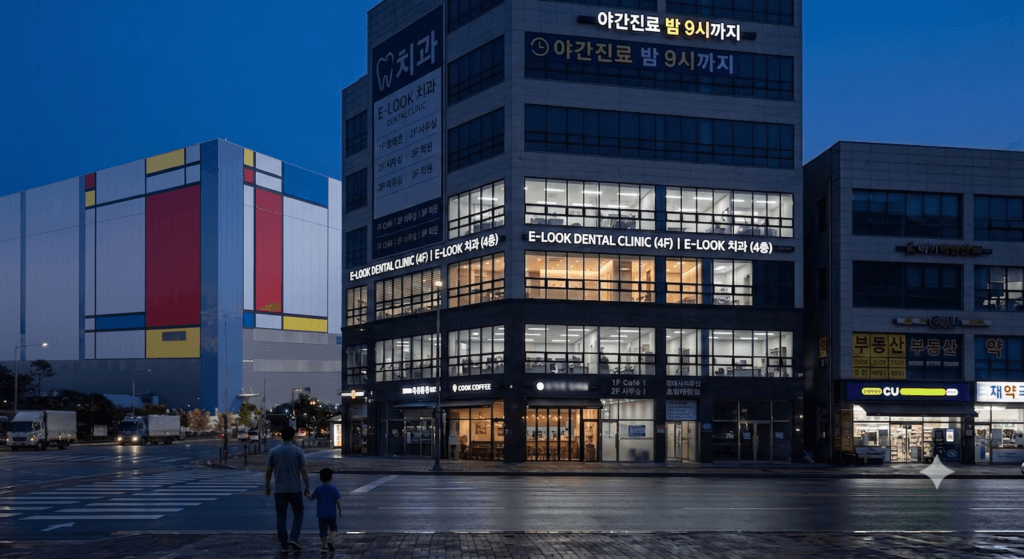
The practical answer is knowing, before anything happens, which dental clinics in your area keep evening, weekend, and holiday hours. They exist — a small number of clinics, ours among them, run 365 days a year with weekday hours into the evening precisely because dental problems don’t respect the calendar. Whichever clinic you identify, save its number in your phone now, along with two details: its last registration time (Korean clinics typically stop accepting patients some time before closing) and whether it can handle TDP paperwork, so an emergency visit doesn’t turn into a claims headache afterward.
A note on TRICARE and emergency visits
Emergency dental treatment for TDP enrollees follows the same claim process as any other care — there’s no separate emergency authorization needed for a family member to walk into a Korean clinic with a broken tooth. What helps later: keep every receipt, and make sure the clinic documents the diagnosis and procedures in a claim-compatible format (CDT codes, ADA Universal tooth numbering — I wrote about this in the TDP guide). Active-duty members are a different case: contact your base dental clinic first when possible, as ADDP has its own referral rules.
Frequently asked questions
Where can I find an emergency dentist near Camp Humphreys or Osan Air Base at night or on weekends? Most Korean dental clinics close evenings, Sundays, and holidays, so identify a clinic with extended hours before you need one. The E-Gen portal (e-gen.or.kr) and 119 list open facilities, but night-time listings are often hospital ERs, which generally don’t have dentists on duty. A few local clinics keep evening, weekend, and holiday hours year-round.
Should I go to a Korean emergency room for a toothache? Usually no. Korean ERs typically have no dentist on duty and will manage only life-threatening issues — spreading swelling, uncontrolled bleeding, fractures — then refer the tooth to a dental clinic. For pain, broken teeth, or lost crowns, a dental clinic is the right destination.
My child knocked out a tooth — what do I do? If it’s a permanent tooth: handle it by the crown, rinse briefly, reimplant it in the socket if you can or store it in cold milk, and get to a dentist within 30–60 minutes. If it’s a baby tooth: do not reimplant it — bring the child and the tooth in, and let the dentist assess.
Can I glue my crown back on temporarily? Not with household glue. Superglue damages the tooth and makes proper recementation harder. Use temporary dental cement from a pharmacy or simply protect the area, and have the crown professionally recemented within a few days.
Does TRICARE cover emergency dental visits in Korea? For TDP-enrolled family members, emergency treatment goes through the normal claim process — no special pre-authorization is needed to visit a Korean clinic. Keep receipts and ensure the clinic documents care in ADA claim format. Active-duty members should contact their base dental clinic first when possible.
This article is for general information and does not replace professional medical or dental advice. In a life-threatening situation, call 119. TDP benefits and procedures are set by federal regulation and change over time — verify coverage with United Concordia (uccitdp.com).