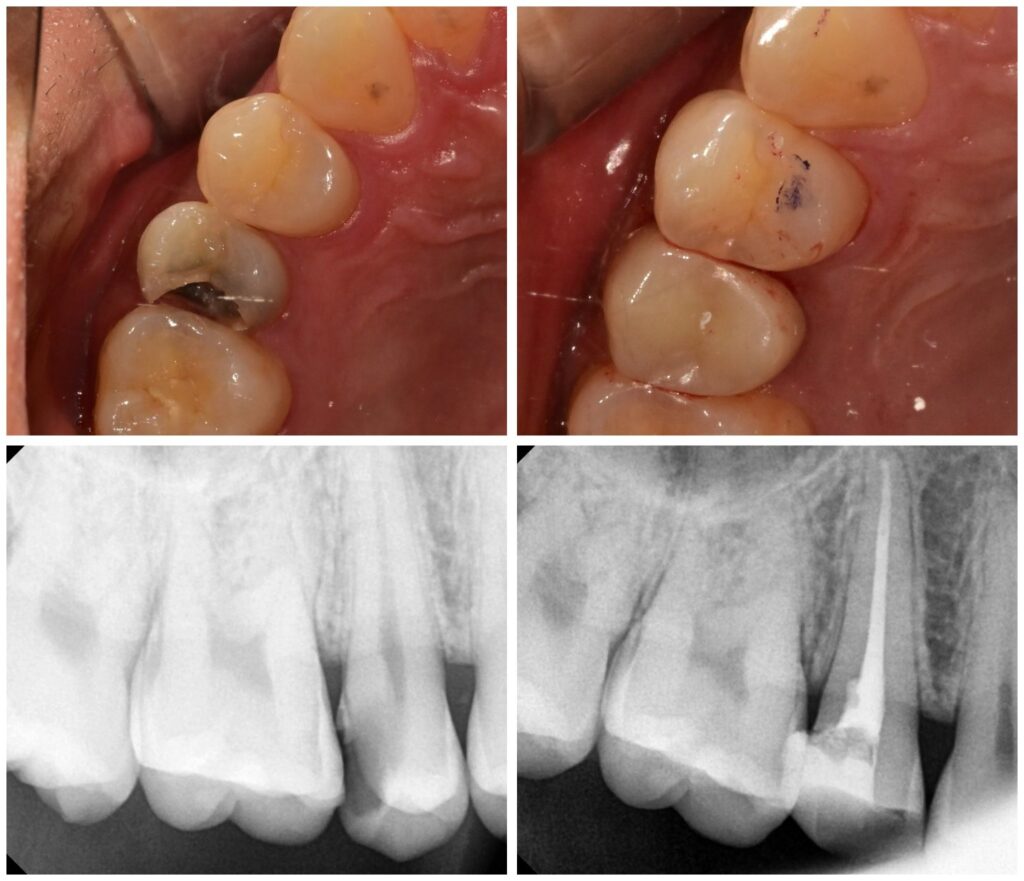
A Badly Decayed Tooth: Extract and Implant, or Save It With a Root Canal and Crown?
Medically reviewed by Dr. Junsang Lee (DDS · Director, 365 E-LOOK Dental) | Last updated: June 2026
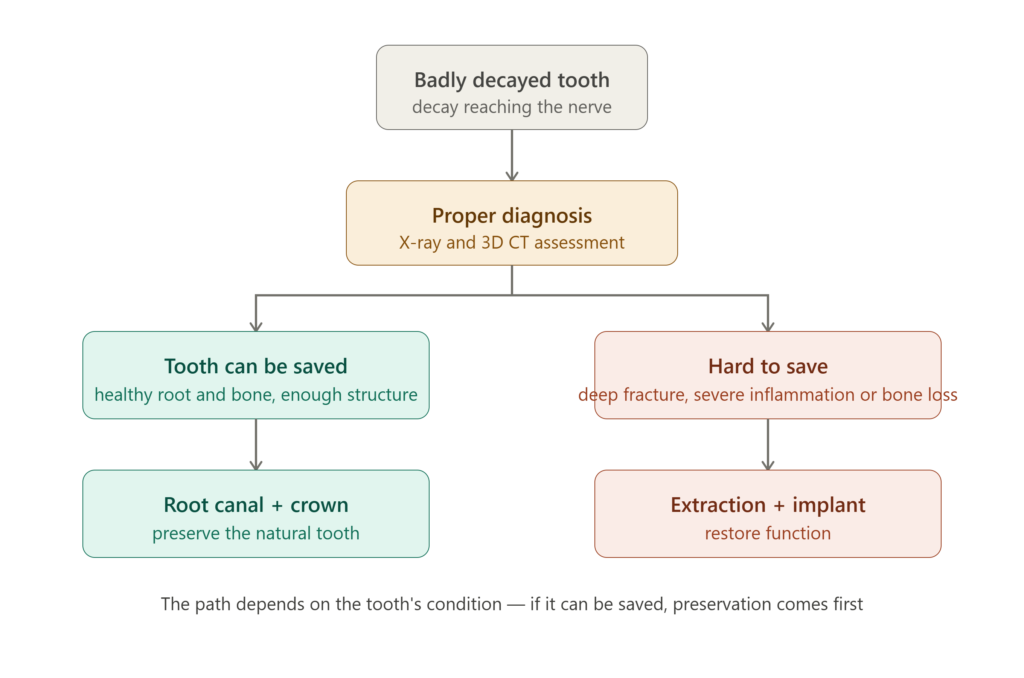
When decay reaches deep into the nerve, patients often face the same question: “Should I have this tooth pulled and replaced with an implant, or can a root canal save it?” The short answer: if a tooth can be saved, preserving the natural tooth comes first. That said, not every tooth can be saved, and depending on its condition, extraction followed by an implant is sometimes the better choice.
This article explains why preserving a natural tooth is the guiding principle, when a root canal versus an implant is appropriate, and what factors the decision rests on.
Why Saving the Natural Tooth Comes First
The basic principle of dental care is to preserve the natural tooth whenever possible. An implant is an excellent way to replace a missing tooth, but it cannot fully reproduce everything a natural tooth does.
Around the root of a natural tooth is a thin tissue called the periodontal ligament. It senses biting force and cushions impact, and it’s the reason you can feel subtle texture and pressure when you chew. An implant fuses directly to bone and has no such ligament, so the sensation of chewing is different from a natural tooth.
For that reason, when a tooth can still be preserved, saving it through a root canal is considered first. Pulling a tooth that could have been kept is not something we recommend.
When Is a Root Canal and Crown the Right Choice?
A root canal removes the damaged nerve and blood vessels (the pulp) from inside the tooth, disinfects the space, and seals it — allowing the tooth itself to be preserved. Even when decay has reached the nerve, if the root and the supporting jawbone around it are healthy, a root canal can save the tooth.
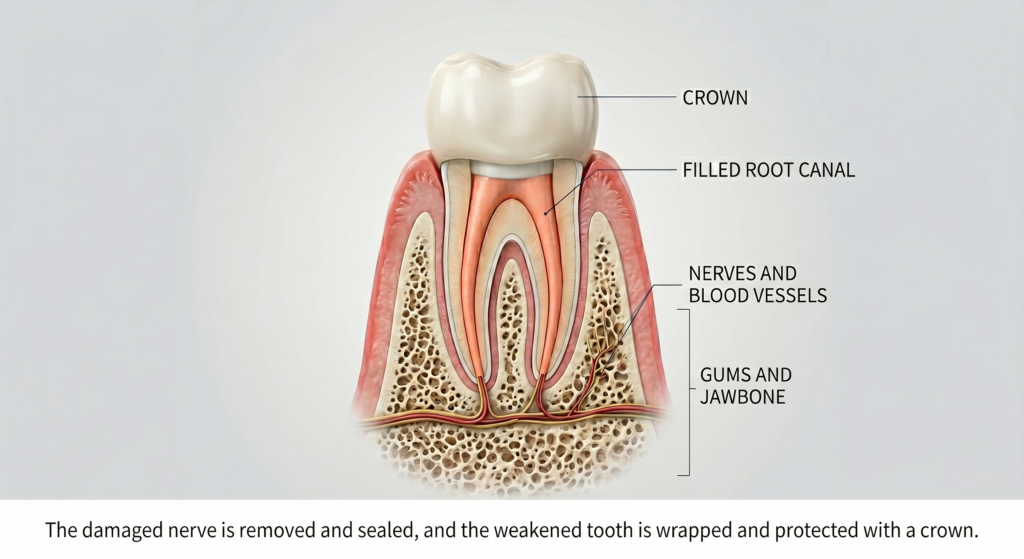
However, a tooth that has had a root canal has had its internal tissue removed, so over time it receives less nourishment and becomes more brittle and prone to fracture. That’s why a crown is usually placed afterward to wrap and protect the tooth. The crown reinforces the weakened tooth so it can withstand chewing forces, helping it last longer.
Many patients wonder how long a root-canal-treated tooth actually lasts. According to a systematic review by the UCL Eastman Dental Institute in London, which pooled the results of many studies, about 87% of root-canal-treated teeth were still in place 8 to 10 years after treatment. Longer-term follow-up studies report that a substantial proportion remain functional even 20 years later. One finding stands out across studies: teeth protected with a crown after a root canal survived longer than those left without one — a clear illustration of why the crown matters. These figures naturally vary with the condition of the tooth and how well it’s cared for, so they don’t apply uniformly to every case.
In short, a root canal and crown is a way to preserve a natural tooth when the root and jawbone are healthy but the inside of the tooth is damaged.
When Is Extraction and an Implant the Right Choice?
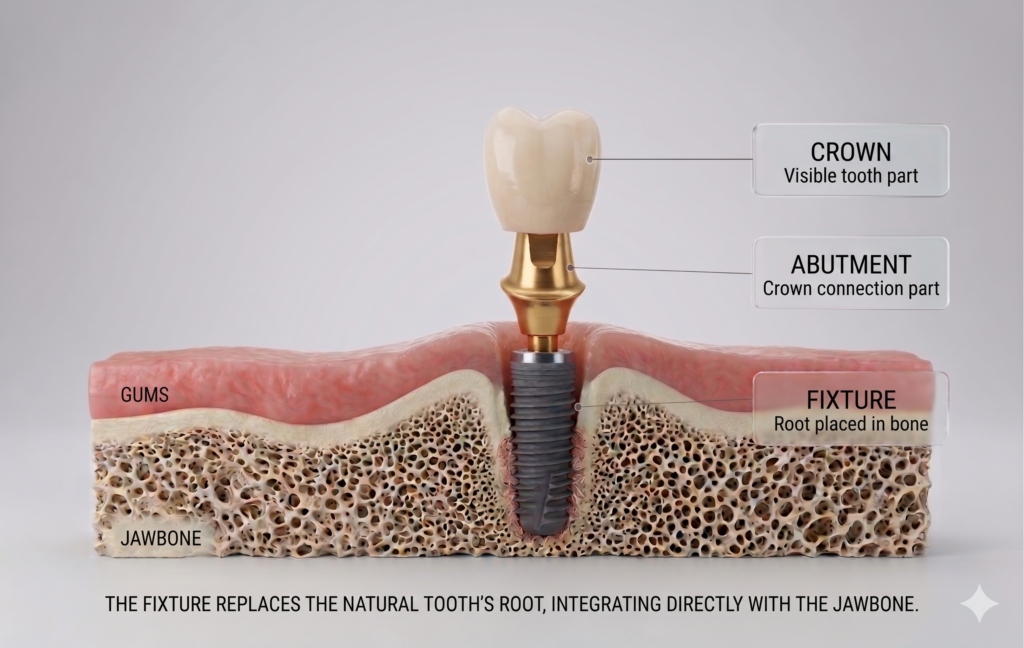
Conversely, there are cases where a tooth is difficult to save, or where saving it wouldn’t last. In these situations, extraction followed by an implant can be the more reasonable option. The most common cases include:
First, when decay or trauma has fractured the tooth deep down to the root. If too little healthy tooth structure remains, a crown cannot reliably hold it together.
Second, when there is severe inflammation at the root tip or significant loss of the jawbone around the root. Without enough foundation to support it, a saved tooth won’t last long.
Third, when a tooth has had root canal treatment that has repeatedly failed. If inflammation persists despite multiple attempts, extraction becomes the reasonable next step.
In these cases, rather than straining to keep the natural tooth, restoring function with an implant after extraction can be more stable over the long term.
What Determines the Decision?
So what guides the choice between saving and extracting? The key is to evaluate several factors together.
The most important is the amount of healthy tooth structure remaining. To restore the tooth with a crown, a certain amount of solid tooth must remain. Next is the condition of the root — whether it is intact and free of fracture, and whether there is inflammation at the root tip. Then there’s whether the jawbone supporting the tooth is sufficient, and finally the role and position of that tooth within the mouth.
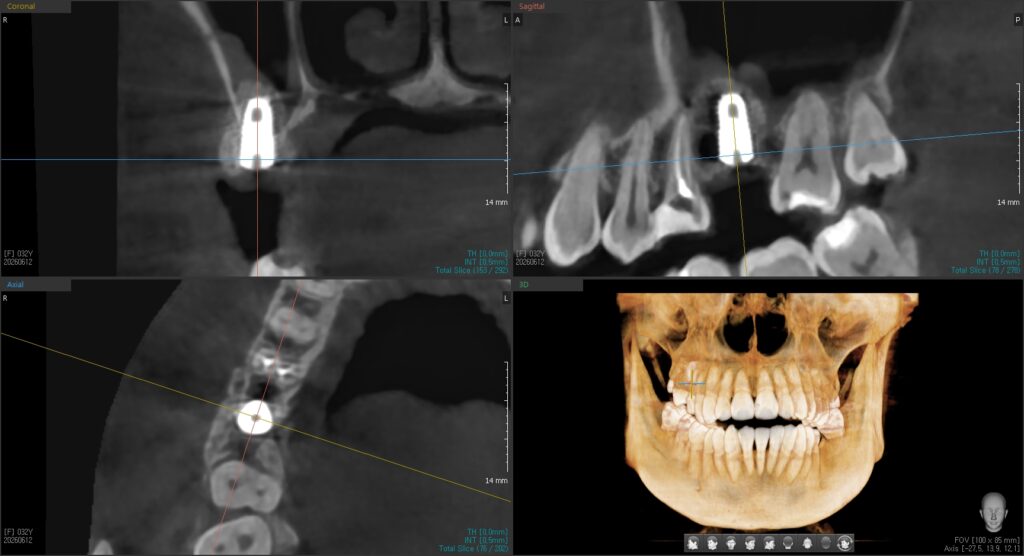
This assessment requires proper diagnosis. A standard X-ray shows the depth of decay and the state of the root, and when needed, a 3D CT scan reveals the bone and the extent of inflammation around the root in three dimensions. Even among teeth described as “badly decayed,” these factors differ from patient to patient, so no single rule applies to everyone.
Common Misconceptions
There are a few misunderstandings patients often have about this topic.
“If it’s going to come out eventually, isn’t it better to just get an implant now?” — Not necessarily. Keeping a natural tooth healthy even one more year has value in itself, and once a tooth is pulled, the surrounding jawbone begins to resorb. If it can be saved, keeping the natural tooth is often the better deal.
“Don’t root-canal-treated teeth fail quickly anyway?” — As noted above, when properly protected with a crown and well maintained, a root-canal-treated tooth can function for many years. Regular care, however, is essential.
“Aren’t implants permanent?” — Implants, too, can develop problems such as peri-implantitis if not maintained. Whether natural tooth or implant, consistent care is what ultimately determines how long it lasts.
A Final Word
The answer to “extract and implant, or save it with a root canal” depends on the condition of the tooth. If a tooth can be saved, preserving the natural tooth comes first; if it cannot, an implant is a good alternative.
What matters most is not rushing this decision without thorough diagnosis. If you’ve been told a tooth is badly decayed, start by confirming its exact condition with proper diagnostic imaging. From there, the better path — saving the tooth or rebuilding it anew — can be found together.
Reference: Ng Y-L, Mann V, Gulabivala K. “Tooth survival following non-surgical root canal treatment: a systematic review of the literature.” International Endodontic Journal, 2010. / Pirani C, et al. “Long-term tooth survival following primary root canal treatment: a 5- to 37-year retrospective observation.” Clinical Oral Investigations, 2023.
This article is for general informational purposes only. Treatment methods and outcomes vary depending on each individual’s oral condition. The survival rates mentioned are research findings and do not guarantee individual treatment outcomes. All procedures carry the possibility of individual variation and complications. Diagnosis and treatment plans must be determined through consultation with your treating clinician.