
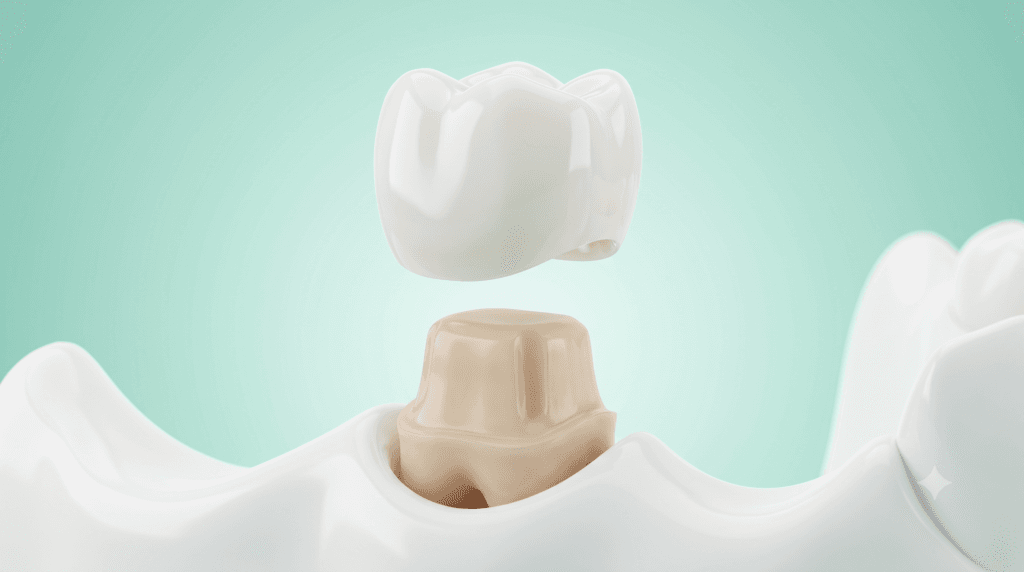
Your Crown Came Off: What to Do Right Now — When It Can Be Recemented and When It Can't
Dr’s Notes
Crowns have a strange talent for coming off on Friday evenings and holiday weekends. Chewing gum or a caramel, flossing, or just eating dinner — and suddenly there’s something hard rolling around in your mouth. In that moment, most people want to know two things: can it go back on? and what do I do right now?
What to do immediately
Don’t throw the crown away. Whether or not it can be recemented, the crown itself is diagnostic evidence. The condition of the cement inside it, the wear pattern, whether a fragment of tooth came out attached to it — all of it points to the cause. Keep it in a small bag or container.
Don’t glue it back on. Superglue and similar adhesives are strictly off-limits. They’re toxic to the tissue, and once the crown sets in even a slightly wrong position, removing it can damage the remaining tooth — and proper recementation becomes impossible. I have genuinely seen this one act of home first-aid turn a savable tooth into an extraction.
Protect the exposed tooth. If the tooth under the crown had root canal treatment, it won’t hurt; if it’s a vital tooth, it may be sensitive to cold. Temporary dental cement or dental wax from a pharmacy can cover it for a day or two. Avoid chewing on that side — a tooth prepared for a crown is structurally weakened, and if it fractures, the entire situation changes.
See a dentist within a few days. Leaving it for weeks because it doesn’t hurt creates a problem of its own: teeth move when space opens up. The opposing tooth drifts down (or up), the neighbors tilt in — and a crown that fit perfectly last week no longer seats. “It doesn’t hurt, I’ll go later” is the single most common route from a recementable crown to a brand-new one.
When the crown can go back on
The simplest reason crowns come off is cement fatigue: years of chewing forces and saliva gradually wash out or crumble the luting cement. If the crown is intact and the tooth inside is healthy, cleaning and surface treatment followed by recementation solves it. If the inside of the crown holds only old cement — no tooth fragments — and the tooth surface in your mouth looks smooth, this is the likely scenario.
When a new crown is needed
Decay under the crown. The crown itself can’t decay, but bacteria can slip through the microscopic gap at the crown margin and rot the tooth underneath. If that’s why the crown came loose — if you can see dark or soft areas inside the crown or on the tooth — the decay must be removed and the tooth reshaped, which means the old crown no longer fits. Deep decay may also mean root canal treatment.
The tooth fractured with it. If a piece of tooth came out embedded in the crown, or the tooth in your mouth broke at the gumline, the options depend on how much sound structure remains: a post and a new crown if enough is left, or an extraction consult if not.
The crown itself is damaged. Chipped porcelain or a perforated metal surface means recementing only reschedules the same failure.
The tooth has already shifted. The scenario described above — the most frustrating one, because the crown is fine and only the space has changed.
Ultimately, recement-or-remake isn’t decided by the crown; it’s decided by the tooth underneath it. That’s why you bring the crown in, and that’s why the dentist examines the tooth before ever trying the crown back on.
Frequently asked questions
Can I wear the crown temporarily until my appointment? For a day or two, lightly seated with pharmacy temporary dental cement, yes. But a loosely seated crown can be swallowed or aspirated during a meal — especially a lower one — so if it doesn’t stay put securely, it’s safer not to force it.
How long does a recemented crown last? If the cause was simply cement fatigue and the tooth is healthy, a recemented crown can serve normally for years. If it keeps coming off repeatedly, that signals a retention problem with the crown’s own height or shape, and remaking it is the better investment.
It doesn’t hurt at all — do I still need to come in? Yes. The absence of pain usually just means the tooth had root canal treatment. Tooth movement and decay both progress painlessly, and every week of delay shrinks the chance of simple recementation.
This article is for general information; individual diagnosis and treatment planning require an in-person examination.